About

I am Christian — and I believe technology is rarely the problem.

The problem is the gap between what technology could do and what people make of it. That is exactly where I work – in research, in the lecture theatre and in projects. Who I am, what has shaped me and which six strengths I can back up with evidence: all of that is here. Numbers and career stages are under Experience.

Portrait: Christian Tuschner
The person behind it

Who I am – and what drives me.

My story in eight chapters.

Degree
M.Sc. Business Informatics
Doctorate
Dissertation submitted 09/2026 · defence expected December 2026
Born
1993
Home
Hackenheim near Bad Kreuznach
Languages
German · English
  1. Where I come from

    Grew up in, and still at home in, Hackenheim near Bad Kreuznach – between vineyards and the A61 motorway, from where Rhine-Main, Rhine-Neckar, Koblenz and Kaiserslautern are all within reach. At 17 I sat in a newsroom for the first time, and the local sports page of the Rhein-Zeitung did not let go of me for eleven years. Sundays meant Kreisliga and A-Klasse football, the text due the same evening, in the paper on Monday morning. Doing that for eleven years alongside school, studies and a job teaches you two things for life: look closely, and write down what matters so that someone understands it over breakfast at seven in the morning.

  2. Where I belong

    Wherever new technology meets an old working routine and nobody has yet said how the two fit together. Between management and case workers, between IT and the business units, between the concept on the slide and Monday morning in the office. I experienced it for the first time at the bank: a new document-management system, a scanning team that had not existed before, and colleagues who had worked with paper for twenty years. Since then I have known that digitalisation is not decided in the project plan but at the desk next door.

  3. How I work

    I am someone who approaches people. And yes, I like to talk – preferably with everyone a project affects, from the decision-maker to the case worker. Talk to only one side and you know only half the story. My routine at work is always the same: first listen and ask, then sort, then put a structure on the table that everyone involved can stand behind – and then get going. What I cope badly with: endless loops without a decision.

  4. What I bring

    Five years of research at the University of Koblenz on what digitalisation and AI do to leadership and collaboration – dissertation submitted. 61 interviews with executives and experts who told me honestly where things get stuck. A sub-project lead with time, resources and budget. The academic lead of an MBA focus area. And eleven years on a sports desk where the text had to be finished on Sunday evening – whatever else the day had brought.

  5. What I am like

    I say what I think – friendly, but clearly. I would rather ask once too often than once too rarely. I am ambitious and a little bit of a perfectionist, but pragmatic when it comes to results. I bring humour and fun along, even into the third hour of a workshop. I keep my word, and expect the same of others. And I am loyal to my team, even when it gets uncomfortable.

  6. What does not suit me

    Slides that nobody ever implements. Digitalisation as a pure IT project. Meetings without a decision. Leadership that consists of control only.

  7. What you get from me

    Someone who brings research, teaching and practice together without sounding like an ivory tower. Who reduces complexity instead of administering it. Who takes along the people who will have to work with the technology in the end, because without them the best system is worth nothing. And who, at the end of a project, would rather show a changed working day than a final presentation.

  8. What recharges me

    Good coffee, honest feedback and people who want to change something. Football – in the stadium, in front of the TV and most of all with the German national team, which under Jürgen Klopp is raising hopes of European and World Cup titles again –, running and cycling through the vineyards, on skis in winter since the age of three, and at the stove, Italian first. Family is non-negotiable. Everything else is covered by the six things and four stations below – the ones that appear in no CV.
Six things that are not on the CV
  • Most of my dissertation was written in evenings and weekends alongside a full teaching load – I know what a marathon next to a full-time job feels like.
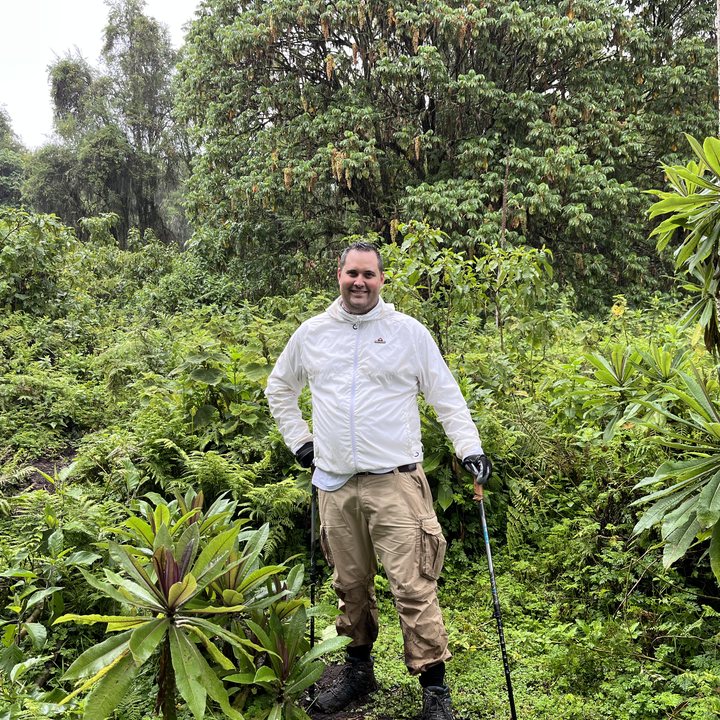
  • A three-and-a-half-week research fellowship in Rwanda taught me more about leadership than many textbooks ever could: context trumps theory.
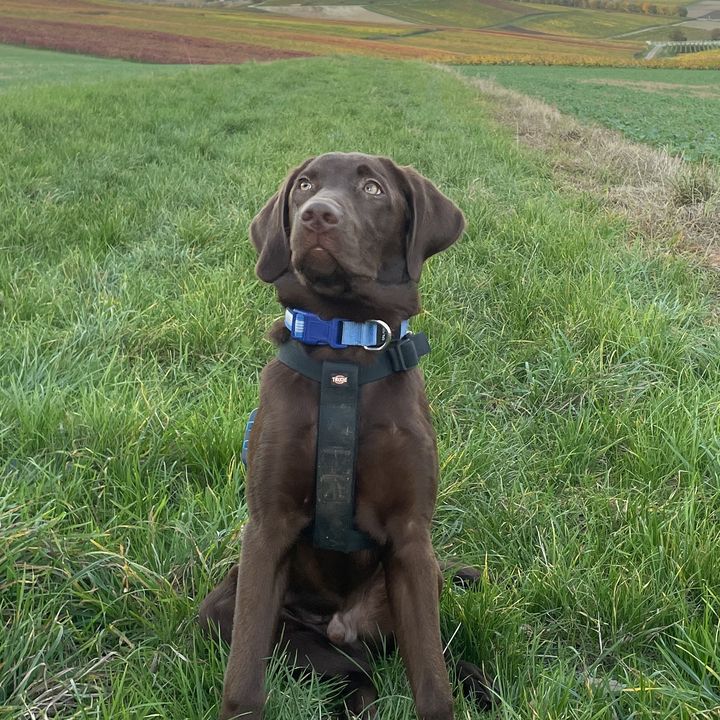
  • For two years now, a Labrador has lived with me. Despite all the textbook knowledge on leadership, he regularly pushes me to my limits – and makes me question every day what leading actually means.
  • For years I played football-manager games from EA and SEGA day in, day out – that is where I first understood what leadership and management in (e-)sports come down to. I have remained a football fan with an eye for detail.
  • I love to travel – Africa, Asia, the Americas, wherever – and I am usually the tour guide for family and friends: planning the route, keeping the group together, having a plan B when the bus does not show up. Leadership on a small scale, without an org chart.
  • At home I tinker with a smart home and have built my own home server (NAS) with Docker containers – both regularly remind me that technology is only as good as its fit with everyday life.

– Christian

Five stations that shaped how I see leadership

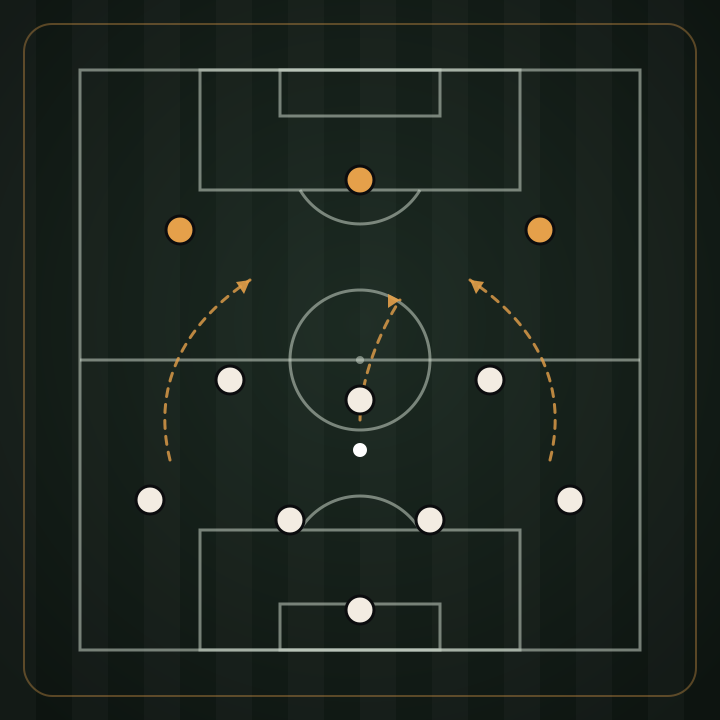
  1. Stylised tactics board with a line-up
    2007 – 2020
    Football Manager

    First leadership experience, as a teenager in front of a screen: virtual pros, real dressing-room crises. Lesson: one star never replaces a team.

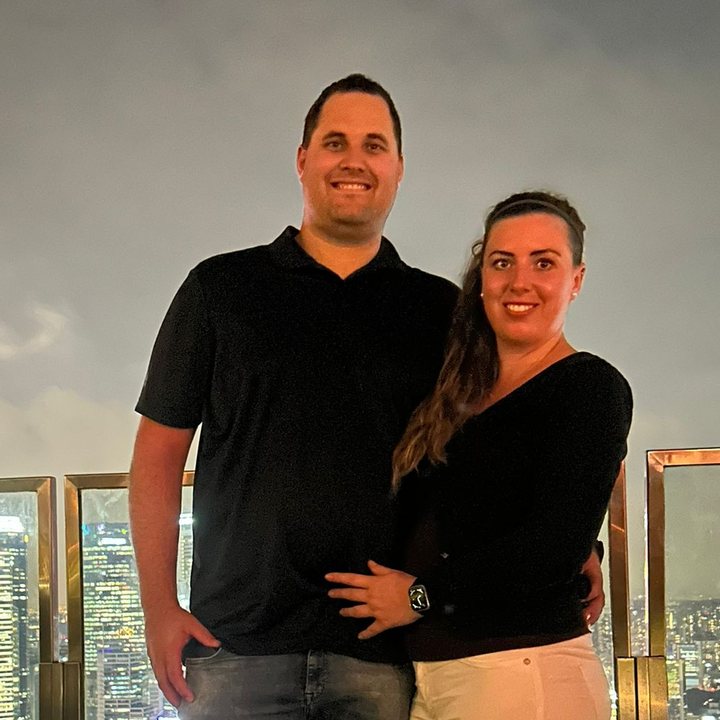
  2. Christian Tuschner with his partner on the observation deck of Marina Bay Sands in Singapore
    since 2015
    Travelling

    I plan the route, the timings and the fallback. My partner makes sure we depart from it every now and then. Lesson: a plan nobody contradicts is rarely the best one.

  3. The bound dissertation on the desk
    2022 – 2026
    Dissertation

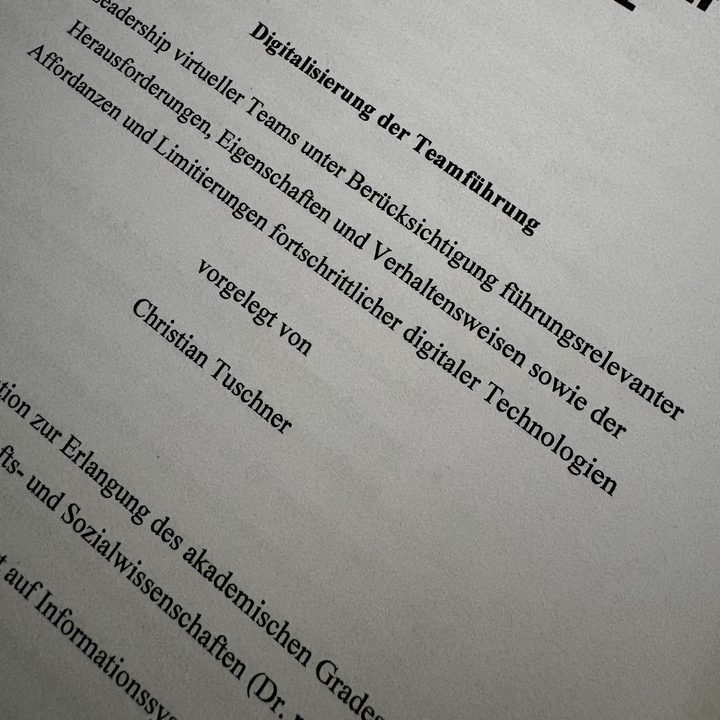
    My father said leading from home office doesn’t work. I argued back: it’s the leader, not the location. 61 interviews later I know how big that question is.

  4. Christian Tuschner hiking in the rainforest in Rwanda
    2023
    Rwanda

    Three and a half weeks in Kigali. My leadership theories travelled with me in the suitcase – what I unpacked there was something else entirely.

  5. Labrador Rio sitting in a meadow in front of vineyards
    2024 – today
    Labrador Rio

    My most demanding team member: listens only when he wants to, negotiates with his eyes – and usually wins. Leadership, renewed daily.

Private photos. The tactics board is an AI-generated illustration (labelled in line with the EU AI Act).

Six strengths

Six strengths – each with evidence

01

Structuring complexity

59 publications from two systematic literature reviews and 61 interviews with executives and experts condensed into one model that brings together challenges, leadership behaviour and technology affordances.

02

Communicating persuasively

At eye level with top management: 36 executives up to C-level won for an interview through direct outreach. Eleven years of newspaper writing under deadline, publications at ECIS and HICSS.

03

Teaching and explaining

Teaching since 2021 for up to 300 students per module and 30–40 professionals and managers per MBA module; at the bank, onboarding of new colleagues and presentations.

04

Taking responsibility

GameLOAP sub-project lead in tandem with a colleague – budget and hiring decided jointly (one staff member, one student assistant); instrumental in building the Volksbank scanning team; editor of the university journal “Junges Forschen”.

05

Persistence and self-organisation

Dissertation with five studies in four years alongside a full teaching load; eleven years of weekend journalism alongside school, studies and job.

06

Understanding and applying technology

VBA investment plan and DMS roll-out at the bank, API interface and LLM chatbots in the project, AI-assisted analysis in research – business informatics in practice, not just on the degree certificate.

Three focus areas

Three fields of contribution, and why me

01
Digital Transformation

Seen from inside, researched from outside

Three years in a cooperative bank, in the middle of a document-management roll-out — the first time I saw what a roll-out does to a business unit. Then, in my Wirtschaftsinformatik studies and in research, the other side: how organisations actually organise and lead digital work, beyond the project plan.

02
AI Adoption

Following the technology into managerial work

The final study of my doctorate asks which leadership tasks AI, VR/AR and metaverse tools can support and where their limits lie — legally, organisationally, humanly. Since 2024 I use generative AI myself: in teaching, in a project with LLM-based chatbots and in analysis, documented and reflected, not merely used.

03
Organisational Change

From describing to shaping

The people side of change is the core of my research: how leaders run virtual teams when technology sits in between. As lead of the MBA focus area “Digitalisierung” and lecturer in change management and leadership I translate it for working managers; as a sub-project lead I have delivered it myself. The next step: doing the same inside organisations.

Download CV

Interested in a conversation?

I am available from February 2027. I welcome conversations about roles in digital transformation, AI adoption and organisational change – on site, hybrid or remote. You can reach me by email or on LinkedIn.